
STRENTHENING FAMILIES IN INDIA Framework and Guidance
Handbook Concerning PERSONS WITH DISABILITIES
Compilation of the Current Aftercare Practices Multiple states, India February 2024
This is a compilation of the information gathered on Aftercare practices from different sources around the as on date practices by state governments and NGOs in different states of India. The information is based on the easy access and availability of information by Udayan Care and is not a exhaustive illustration. The objective of this compilation is to understand and plan an exposure cum learning visit to officials of the Bihar state functionaries and to see some of the existing good work being carried out in those states, so that the elements of them can be contextualized and replicated in the state of Bihar. The document also aims to shed light on the housing models existing in different states, so that the Govt. of Bihar can pilot the setting up of a community group housing project for care leavers in the state. It is important to note that there is no clarity on the registration of aftercare residential facilities run by voluntary organizations or the government under the JJ Act 2015, perhaps due to the fact that law envisages Aftercare as a non-institutional model and while it does prescribe community group housing under Rule 25 of JJ Rules, norms for its set up and monitoring are not elaborated
Summary of Key Provisions of the Model Guidelines on Foster Care, 2024 in Comparison with the 2016 Guidelines
On 26th April, 2024, the Ministry of Women and Child Development, Government of India issued the Model Guidelines for Foster Care, 2024, revised in light of the 2021 amendment to the Juvenile Justice (Care and Protection of Children) Act, 2015, and the 2022 amendment of the Juvenile Justice (Care and Protection of Children) Model Rules. The 2024 Foster Care Guidelines has introduced several new provisions in alignment with the amended JJ Act, JJ Model Rules, and Adoption Regulations, 2022, and have simplified many other provisions which were existing in the 2016 Foster Care Guidelines. This document concentrates on key provisions of the 2024 Foster Care Guidelines and compares it with the 2016 version. For ease of reference, paragraph number of the respective Guidelines where particular provisions can be found has been highlighted, since only a shortened version is included in this document. Author – Satyajeet Mazumdar, Niyati Trivedi – Catalysts for Social Action
Policy Environment Around Rehabilitation of Care Leavers
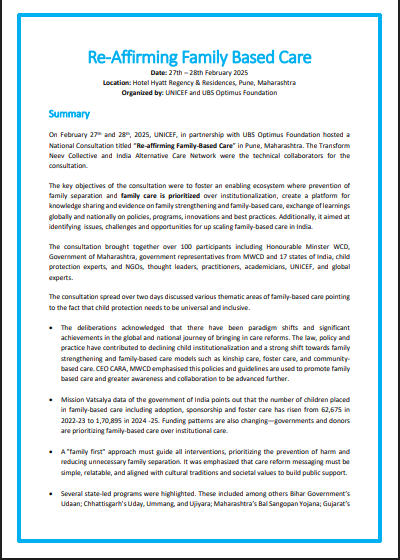
Re-affirming Family-Based Care
Strengthening Families in India: Guidance and Framework _ by IACN & CTWWC
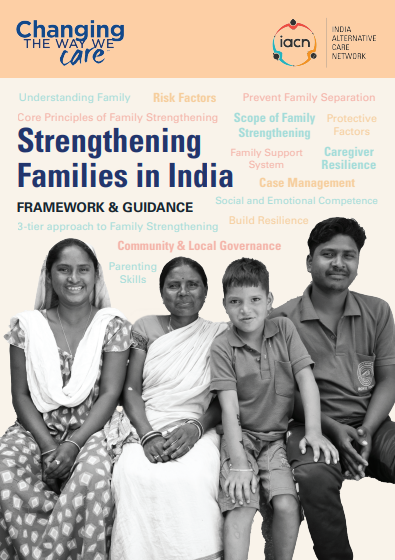
The document titled Strengthening Families in India: Framework and Guidance has been jointly developed by IACN and CTWWC. It is an effort to consolidate existing knowledge, interventions, and promising practices championed by governments and civil society organizations across the country. At the heart of this document lies the need to increase accessibility to social protection schemes, empower communities through local governance institutions like Panchayati Raj Institutions (PRIs) and Urban Local Bodies (ULBs), and ensure meaningful convergence across sectors.
A Brief Mapping of Policy, Discourse, Law & Practices on Aftercare For Neo-Adults In India
A Brief Mapping of Policy, Discourse, Law & Practices on Aftercare For Neo-Adults In India
Bringing Care Experience to Social Work Capacity Building | A Report

Bringing Care Experience to Social Work Capacity Building | A Report – by Global Social Service Workforce Alliance, Miracle Foundation – India and Child Frontiers
Bringing Care Experience to Social Work Capacity Building | Training Toolkit: Facilitators Manual
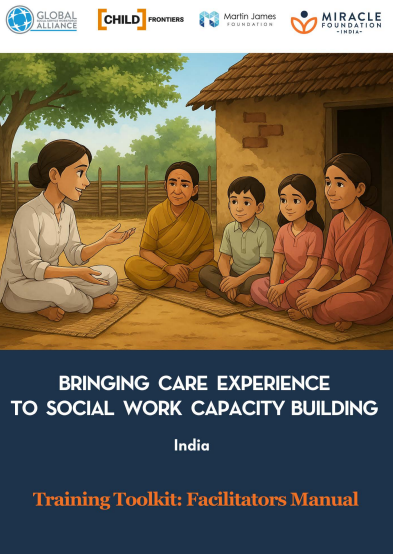
Bringing Care Experience to Social Work Capacity Building | Training Toolkit: Facilitators Manual – by Global Social Service Workforce Alliance, Miracle Foundation – India and Child Frontiers