
Supporting Youth Leave Care: A Study of Aftercare Practices in Delhi

Current Aftercare Practices (CAP) is a research study conducted in the State of Delhi and is part of a multistate study conducted in Karnataka, Rajasthan, Gujarat, and Maharashtra. The CAP study is an Udayan Care initiative, supported and funded by UNICEF, Tata Trusts and other partners; and is base d on the premise that every child who leaves an Alternative Care setting on completing 18 years of age (or becomes a ‘Care Leaver’) needs extended support in the form of Aftercare. The CAP study gathers evidence through a scientific data collection process, consolidates knowledge and promising practices, and discusses gaps and challenges from multi-stakeholders’ perspective. At various stages, the study has employed participatory methods to incorporate the voices of CLs and critical feedback from key stakeholders and experts.
Before, Not After: An Evaluation of CINI’s Preventative Approach to Child Protection in India
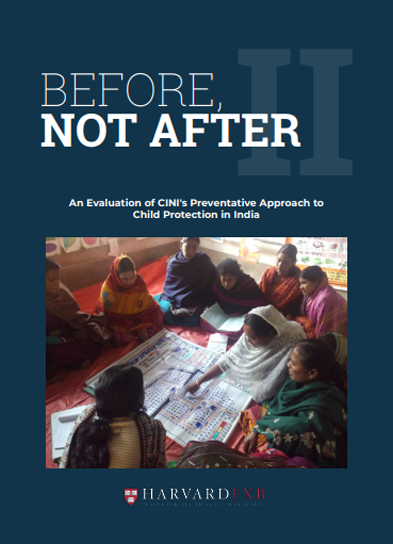
This report documents innovative community strategies for preventing serious violations of children’s rights. This report describes CINI’s “systems strengthening” approach to improve holistic overall functioning of child protection systems so that different types of harm and violence against childre n are prevented from occurring.
Alternative Care in India: Issues and Prospects

This paper presents the current vulnerabilities faced by children and the scenario of child protection in India. While discussing the legal provisions prevailing in the country, it sheds light on the socio-cultural barriers that are creating resistance within the society in making the Alternative Ca re model a success.
Tools for Working with Children in Institutional Care

This knowledge resource discusses and provides examples of practice tools, worksheets and calming techniques (in English and Hindi) which counsellors and adults can use while working with children who are in institutional care. These tools are developed and compiled by Counsel to Secure Justice (CSJ ) based on experiences and interventions of working with children in institutions. Along with the tools, the paper reviews evidence on the impact of institutionalisation on children and evidence-based interventions that can help mitigate this impact while interweaving CSJ’s experiences and interventions. The latter part of the paper presents tools and calming techniques in the form of worksheets and pictorial representations. The tools and techniques in this resource are part of CSJ’s interventions with children in CCIsincluding in the form of in-person interactions/counselling, virtual interventions during COVID 19 and the restorative circle processes. The tools are developed and compiled to provide visual aid and illustration during counselling and other interactions with children. The exercises can help in engaging children to think and express. The tools can help build rapport and work with children who find it difficult to express their emotions and experiences verbally. The worksheets and calming techniques around coping can help the children practise the coping techniques and equip them to use it for themselves. CSJ understands these tools have limitations and are examples of practice tools and techniques adapted or modified by the counsellors. These are not a replacement of in-person, telephonic, individual or group counselling, therapy or any psychological/psychiatric intervention for severe mental health conditions and disorders. None of these tools can be used for psychological or psychometric testing or diagnosis.
Beyond 18 : Leaving Child Care Institutions – Supporting Youth Leave Care: A Study of Aftercare Practices
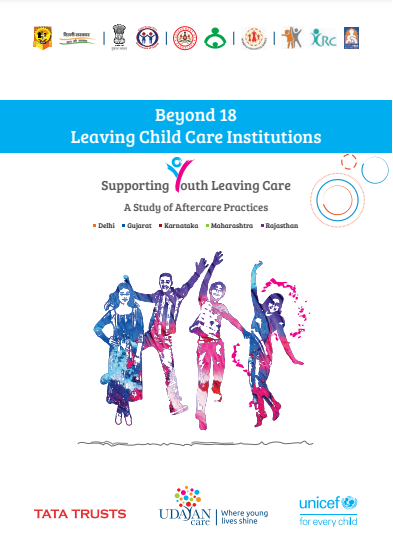
This report on Aftercare is based on research on “Current Aftercare Practices” (CAP), with regard to Children in Need of Care and Protection (CNCP), under the JJ Act, 2015, conducted in five states of India, Delhi, Gujarat, Karnataka, Rajasthan and Maharashtra. It is about the status of Aftercare yo uth, or Care Leavers (CLs), who as wards of the state in the child protection system, while they were below the age of eighteen, we are entitled to care, protection, treatment, development, rehabilitation and re-integration by the state – as explicitly stated in the Preamble of the JJ Act, 2015. On attaining the age of majority – i.e. eighteen years, they are now compelled to transition from state care in a Child Care Institution (CCI) to adulthood in the wider community. The study aims to influence the contemporary care leaving policy, law and practice in India.
VULNERABILITIES ASSESSMENT OF CHILDREN AND FAMILIES
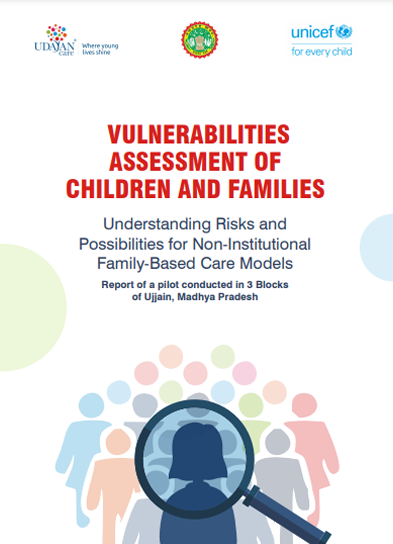
The Government of Madhya Pradesh, committed to child protection in its State Plan of Action on Alternative Care, 2018 where it stated a clear mandate to promote family-based models of alternative care, including family strengthening programs. Keeping this in mind the CPF of Ujjain conducted its firs t pilot Child Vulnerability Mapping (CVM) from December 2020 to February 2021 in three blocks of the district (Ujjain, Badnagar and Nagda) with technical support from Udayan Care. This report is a documentation of the process and highlights the key findings of the CVM along with recommendations for the way forward. The CVM received overall support and guidance from the Department of Women and Child Development, Govt. of Madhya Pradesh and UNICEF MP Field Office.
Kinship Care in India- A Case Study Documentation

This report emerges from the strong conviction of India Alternative Care Network (IACN) that all children deserve to grow up in loving and nurturing family environments. Families are essential for the emotional, physical, and cognitive growth of children. Hence all efforts should be made to provide family-based care to children without parental care, and institutionalisation should be a measure of last resort for the optimum development of children.
Handbook for Facilitation of Restorative Practices in Child Care Institutions
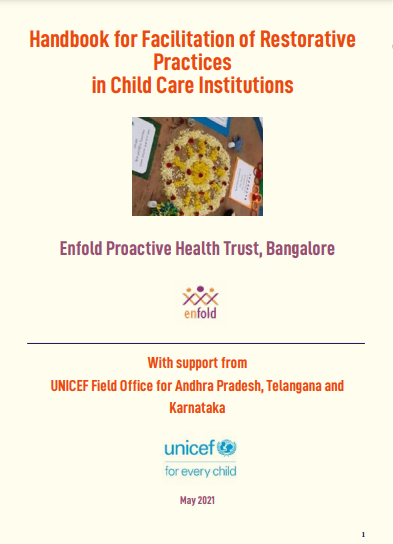
Restorative Circles are part of a wider continuum of practices in Restorative Justice, which include both formal and informal processes. These may include restorative conversations, Family Group Conferences, VictimOffender Dialogues, and Restorative Circles. Restorative Circles can also be of many t ypes. This Handbook focuses on the work undertaken by the Restorative Practices Team at Enfold, with children residing in CCIs. Since 2019, the Restorative Practice team at Enfold Proactive Health Trust has been facilitating Restorative Circles with the staff and children of Observation Homes, Place of Safety, and Children’s Homes under the Juvenile Justice (Care and Protection of Children) Act, 2015. This Handbook has been developed to share the insights that have emerged from our experience of facilitating over 250 Circles with children and adults. We believe that Restorative Practice is a way of life, and so our understanding and practice of Restorative Circles will always continue to evolve. Therefore, this Handbook is an initial offering gleaned from our learning so far, learning that has come from engagement with theory and conceptual frameworks and with practice with children and our team through regular Praxis. We hope this will be useful for organisations and individuals who have undergone basic training on Restorative Circles and wish to facilitate Circles with children in CCI or other settings.
Aftercare Strategic Overview 2020-21

After successfully working with children in child care institutions over the years, Make A Difference started tracking the outcomes of care leavers beyond child care institutions. Make A Difference conducted multiple research to identify some critical drivers that act as a potential barrier for care leavers to achieve outcomes equitable with the middle class. Based on the data from the research and the need analysis, Make A Difference initiated Aftercare intervention in 2014 intending to build a long term holistic intervention extending until the age of 28 depending on the support required for the care leaver. Make A Difference believes stability across four broad areas together would provide the necessary foundations required for the care leavers to achieve and sustain middle-class outcomes. These areas include personal, financial, living and family conditions of the care leavers. Make A Difference has identified some key trajectory points or events that affect an individual’s ability to continue or to progress towards a healthy and stable middle-class life. Factoring in the strategies and the aftercare theories of change, Make A Difference has developed an age transitional model for the aftercare demography which is built along three stages or bands of aftercare intervention. These bands are primarily based on the age group of the care leaver, and the support required to prioritise interventions better depending on what the care leaver needs at any given age. The primary delivery model for aftercare interventions at Make A Difference is through self-support groups, this model is targeted to build long term self-sustainable communities of care leavers in the cities that aftercare programme is currently operating in.
2021 BICON Conference Report
BICON 2021 was an opportunity for government and intergovernmental representatives, civil society organisations, practitioners, academics and most importantly care experienced young people to come together and discuss the most pressing issues regarding children’s care in Asia. With a focus on implem entation, practitioners shared examples of innovation, highlighted promising practices, and showcased local solutions to challenges faced by countries across Asia.