
Supporting Youth Leave Care: A Study of Aftercare Practices, in Rajasthan (2019)
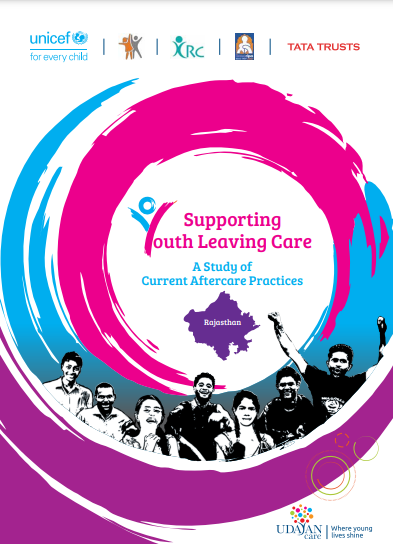
Current Aftercare Practices (CAP) is a research study conducted in the State of Rajasthan and is part of a multistate study conducted in Delhi, Gujarat, Karnataka, and Maharashtra. The CAP study is an Udayan Care initiative, supported and funded by UNICEF, Tata Trusts and other partners; and is base d on the premise that every child who leaves an Alternative Care setting on completing 18 years of age (or becomes a ‘Care Leaver’) needs extended support in the form of Aftercare. The CAP study gathers evidence through a scientific data collection process, consolidates knowledge and promising practices, and discusses gaps and challenges from multi-stakeholders’ perspective. At various stages, the study has employed participatory methods to incorporate the voices of CLs and critical feedback from key stakeholders and experts. The report covers a total of 98 young adults from Rajasthan, comprising of 40 males and 58 females CLs, from both Government and NGO-run Child Care Institutions (CCIs) and 17 youth who, as children, availed the benefits under the Palanhar scheme of the Rajasthan Government. A total of 25 key informants were also interviewed as part of the study. Currently, Aftercare provision under the JJ Act and its Rules is meant only for CLs exiting from CCIs and is not applicable for Palanhar beneficiaries in the State. Although much work on child protection is happening in the State, there are many areas, one of them being Aftercare, where duty bearers need to rise to the call to meet the aspirations of the youth and CLs.
Building a Life: Akbar’s Story
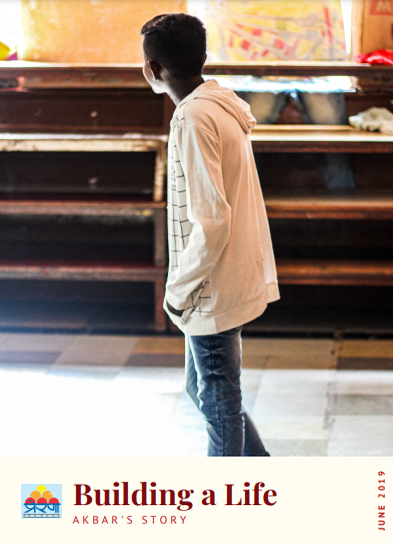
‘Building a life’ is a story of a now 21-year-old Akbar hailing from the infamous red-light area of Kamathipura, Mumbai. This story best explains how Prerana’s interventions were guided by the principles under the JJ Act, 2015 – the principle of best interest, family responsibility, and institution alization as a measure of last resort for rehabilitation. Akbar’s journey, from 2005 till date, comprises overcoming innumerable challenges innate to the red-light area (from being in and out of childcare institutions to dealing with severe medical conditions, and so on), forming strong familial bonds, and building a dream and a life of rights, choices, and dignity. Throughout Akbar’s journey, Prerana has been instrumental in ensuring that he and his family (his mother and four siblings) receive timely counseling, regular medical assessments, enrollment in educational and recreational programs, and rehabilitation whenever necessary through regular follow-ups and outreach.
User Guide on Foster Care
This User Guide aims to provide a comprehensive approach to the development of a good quality foster care service, which will be useful for a range of practitioners including the Child Welfare Committee (CWC) responsible for approval and monitoring of foster families, District Child Protection Unit (DCPU) responsible for developing the foster care service, NGOs who may support foster care, and any individual or organisation who has a role to play.
Mapping Long-term Outcomes of Institutionalization for Children in Need of Care and Protection (CNCP) in India
This research maps the long term outcomes of institutional care on children in India and is undertaken by Make A Difference; a non-profit working with children in need of care and protection (CNCP) across 23 cities in India with the long term aim of driving transformative life outcomes on par with t he middle class for all children in care. Approximately 35m children are estimated to fall into the CNCP category, with nearly half a million registered in institutional care and potentially half a million more in institutions that are yet to register as per the 2015 amendment to the JJ Act, which is still only slowly percolating into local awareness. The goal of this research is to challenge or validate the assumptions that underpin existing impact and change-focused solutions; to combat the complete dearth of data and lack of meaningful information available in the sector about the longer-term effects of institutional care on children in India, and to enable programmes both within and outside of Make A Difference to be designed on the back of benchmarked and trackable outcomes.
Supporting Youth Leave Care: A Study of Aftercare Practices in Maharashtra (2019)
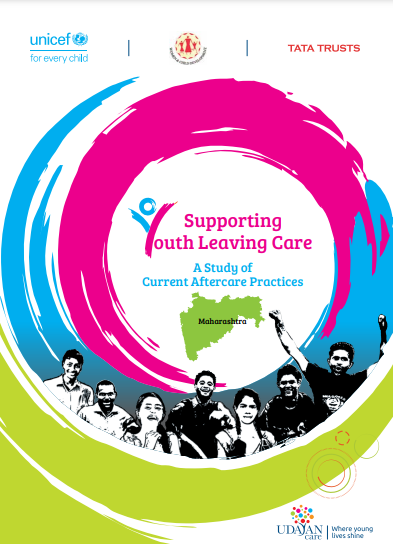
Current Aftercare Practices (CAP) is a research study conducted in the State of Maharashtra and is part of a multistate study conducted in Delhi, Gujarat, Karnataka, and Rajasthan. The CAP study is an Udayan Care initiative, supported and funded by UNICEF, Tata Trusts and other partners; and is base d on the premise that every child who leaves an Alternative Care setting on completing 18 years of age (or becomes a ‘Care Leaver’) needs extended support in the form of Aftercare. The CAP study gathers evidence through a scientific data collection process, consolidates knowledge and promising practices, and discusses gaps and challenges from multi-stakeholders’ perspective. At various stages, the study has employed participatory methods to incorporate the voices of CLs and critical feedback from key stakeholders and experts. The report covers a total of 107 CLs from Maharashtra, comprising of 74 males and 33 females, from both Government and Non-Governmental Organisation (NGO) run Child Care Institutions (CCIs). The key findings of the study show that Maharashtra has a rich historical background of Aftercare, yet there is tremendous scope for further development. Although, much is happening on Aftercare in the State, there are many areas where we, as duty-bearers, need to rise to the call to meet the aspirations of the CLs.
Essence and Scope of Strengthening Community-Based Preventive Child Care and Protection Systems in India
This article reflects different programmes and resource components that may be promoted to keep children with either their own family or within alternative family care, satisfying the rights of their overall development.
CHILD RIGHTS IN JEOPARDY: CHALLENGES IN RECRUITING FAMILIES FOR FOSTER CARE IN INDIA
This article ‘Child Rights In Jeopardy: Challenges In Recruiting Families For Foster Care In India’ is an attempt to broadly view the issues and challenges of foster family recruitment specifically targeted in the Indian context.
Summary Report Mid-term Review for Family Based Care Pilot Project with Base Model CCIs
In March 2019, Miracle Foundation collaborated with two Child Care Institutions (CCIs): Gokul Balika Ashram for girls – Matrumandir (Devrukh – Ratnagiri, Maharashtra) and AARAMBH Boys home (Indore, Madhya Pradesh) to create a replicable model for other CCIs to effectively help children in transition to Family-Based Alternative Care through systemic change by engaging multiple stakeholders. This pilot initiative is for a period of two years (Year 1: March 2019 – April 2020, Year 2: April 2020 – March 2021). This report is a documentation of the mid-term review of the project at the end of one year and provides learnings and challenges so far. It also gives an opportunity to reflect and make a course correction and to track the progress of the project indicators as per the plan.
Supporting Youth Leave Care: A Study of Aftercare Practices in Karnataka (2019)

Current Aftercare Practices (CAP) is a research study conducted in the State of Karnataka and is part of a multistate study conducted in Delhi, Gujarat, Rajasthan, and Maharashtra. The CAP study is an Udayan Care initiative, supported and funded by UNICEF, Tata Trusts and other partners; and is base d on the premise that every child who leaves an Alternative Care setting on completing 18 years of age (or becomes a ‘Care Leaver’) needs extended support in the form of Aftercare. The CAP study gathers evidence through a scientific data collection process, consolidates knowledge and promising practices, and discusses gaps and challenges from multi-stakeholders’ perspective. At various stages, the study has employed participatory methods to incorporate the voices of CLs and critical feedback from key stakeholders and experts. The report covers a total of 108 CLs from Karnataka, comprising of 47 males and 61 females, from both Government and NGO-run Child Care Institutions (CCIs). The key findings of the study show that there is tremendous scope for development of Aftercare in the State of Karnataka. There are many areas where we, as duty-bearers, need to rise to the call to meet the aspirations of the CLs.
Standard Operating Procedure for care and protection of children in street situations
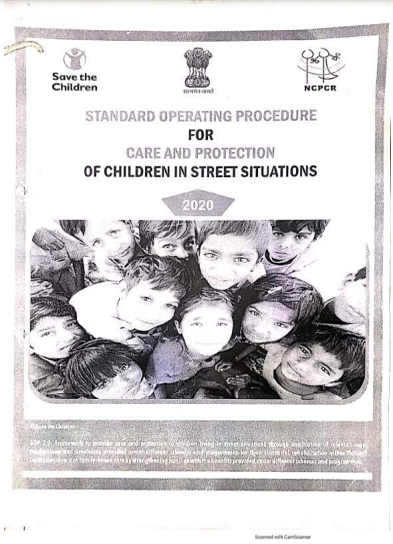
Developed by National Commission for Protection of Child Rights and Save the Children, this framework serves as a comprehensive guidebook for addressing myriad needs of street-connected children. SOP 2.0 makes pertinent recommendations when it comes to using existing legal frameworks and social welf are schemes for improving the lives of children living on the streets across India. This milestone document is a guidebook for various stakeholders when it came to addressing the unique needs of street-connected children.