
Essence and Scope of Strengthening Community-Based Preventive Child Care and Protection Systems in India
This article reflects different programmes and resource components that may be promoted to keep children with either their own family or within alternative family care, satisfying the rights of their overall development.
CHILD RIGHTS IN JEOPARDY: CHALLENGES IN RECRUITING FAMILIES FOR FOSTER CARE IN INDIA
This article ‘Child Rights In Jeopardy: Challenges In Recruiting Families For Foster Care In India’ is an attempt to broadly view the issues and challenges of foster family recruitment specifically targeted in the Indian context.
Summary Report Mid-term Review for Family Based Care Pilot Project with Base Model CCIs
In March 2019, Miracle Foundation collaborated with two Child Care Institutions (CCIs): Gokul Balika Ashram for girls – Matrumandir (Devrukh – Ratnagiri, Maharashtra) and AARAMBH Boys home (Indore, Madhya Pradesh) to create a replicable model for other CCIs to effectively help children in transition to Family-Based Alternative Care through systemic change by engaging multiple stakeholders. This pilot initiative is for a period of two years (Year 1: March 2019 – April 2020, Year 2: April 2020 – March 2021). This report is a documentation of the mid-term review of the project at the end of one year and provides learnings and challenges so far. It also gives an opportunity to reflect and make a course correction and to track the progress of the project indicators as per the plan.
Supporting Youth Leave Care: A Study of Aftercare Practices in Karnataka (2019)

Current Aftercare Practices (CAP) is a research study conducted in the State of Karnataka and is part of a multistate study conducted in Delhi, Gujarat, Rajasthan, and Maharashtra. The CAP study is an Udayan Care initiative, supported and funded by UNICEF, Tata Trusts and other partners; and is base d on the premise that every child who leaves an Alternative Care setting on completing 18 years of age (or becomes a ‘Care Leaver’) needs extended support in the form of Aftercare. The CAP study gathers evidence through a scientific data collection process, consolidates knowledge and promising practices, and discusses gaps and challenges from multi-stakeholders’ perspective. At various stages, the study has employed participatory methods to incorporate the voices of CLs and critical feedback from key stakeholders and experts. The report covers a total of 108 CLs from Karnataka, comprising of 47 males and 61 females, from both Government and NGO-run Child Care Institutions (CCIs). The key findings of the study show that there is tremendous scope for development of Aftercare in the State of Karnataka. There are many areas where we, as duty-bearers, need to rise to the call to meet the aspirations of the CLs.
Standard Operating Procedure for care and protection of children in street situations
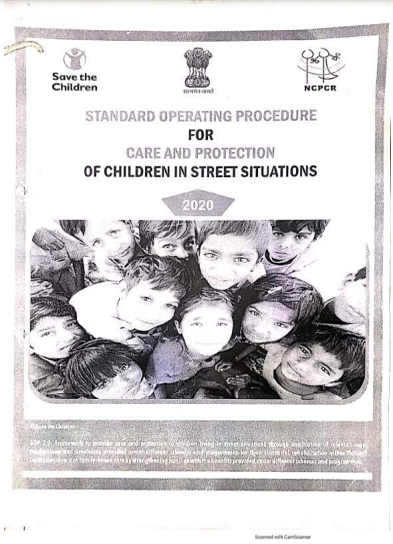
Developed by National Commission for Protection of Child Rights and Save the Children, this framework serves as a comprehensive guidebook for addressing myriad needs of street-connected children. SOP 2.0 makes pertinent recommendations when it comes to using existing legal frameworks and social welf are schemes for improving the lives of children living on the streets across India. This milestone document is a guidebook for various stakeholders when it came to addressing the unique needs of street-connected children.
Family-Based Alternate Care for Children (FBACC)
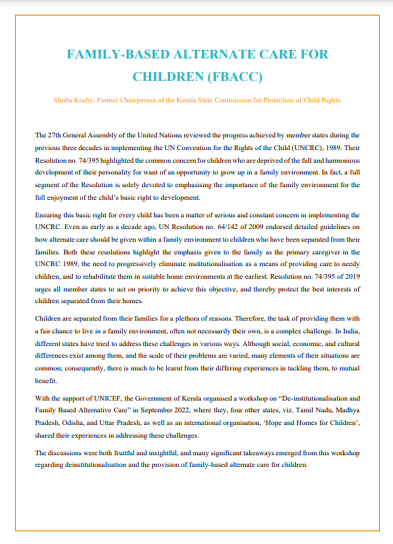
This report talks about the significant takeaways from the workshop on “De-institutionalisation and Family Based Alternative Care” organised by the Government of Kerala with the support of UNICEF, where they, four other states, viz. Tamil Nadu, Madhya Pradesh, Odisha, and Uttar Pradesh, as well as a n international organisation, ‘Hope and Homes for Children’, shared their experiences in addressing these challenges.
Summary Report Mid-term Review for Family Based Care Pilot Project with Base Model CCIs
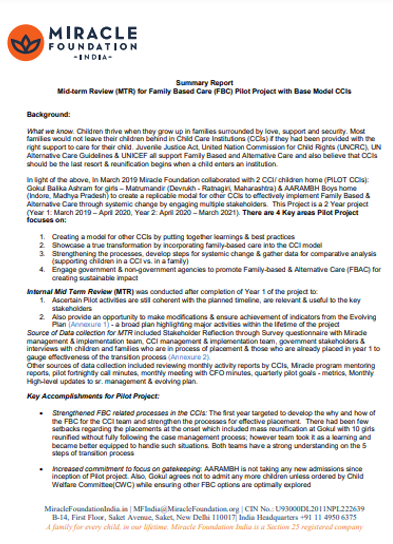
In March 2019, Miracle Foundation collaborated with two Child Care Institutions (CCIs): Gokul Balika Ashram for girls – Matrumandir (Devrukh – Ratnagiri, Maharashtra) and AARAMBH Boys home (Indore, Madhya Pradesh) to create a replicable model for other CCIs to effectively help children in transition to Family-Based Alternative Care through systemic change by engaging multiple stakeholders. This pilot initiative is for a period of two years (Year 1: March 2019 – April 2020, Year 2: April 2020 – March 2021). This report is a documentation of the mid-term review of the project at the end of one year and provides learnings and challenges so far. It also gives an opportunity to reflect and make a course correction and to track the progress of the project indicators as per the plan.
Supporting Youth Leave Care: A Study of Aftercare Practices in Gujarat (2019)

Current Aftercare Practices (CAP) is a research study conducted in the State of Gujrat and is part of a multistate study conducted in Delhi, Karnataka, Rajasthan, and Maharashtra. The CAP study is an Udayan Care initiative, supported and funded by UNICEF, Tata Trusts and other partners; and is based on the premise that every child who leaves an Alternative Care setting on completing 18 years of age (or becomes a ‘Care Leaver’) needs extended support in the form of Aftercare. The CAP study gathers evidence through a scientific data collection process, consolidates knowledge and promising practices, and discusses gaps and challenges from multi-stakeholders’ perspective. At various stages, the study has employed participatory methods to incorporate the voices of CLs and critical feedback from key stakeholders and experts. The report covers a total of 104 CLs from Gujarat, comprising of 63 males and 41 females, from both Government and NGO-run Child Care Institutions (CCIs). The present document also includes children who avail the benefits under the Palak Mata Pita Yojna (PMPY) scheme of the Gujarat Government. Out of 104 CLs, 20 children are PMPY beneficiaries who do not come under the purview of the Juvenile Justice (Care and Protection of Children) Act, 2015 (JJ Act). Currently, Aftercare provision is meant only for CLs exiting from CCIs and is not applicable for PMPY beneficiaries in the state. Although much is happening on Aftercare in the State, there are many areas where we as duty-bearers need to rise to the call to meet the aspirations of the CLs.
Webinar Report Gatekeeping as a Systematic Process: Preventing Child’s Separation
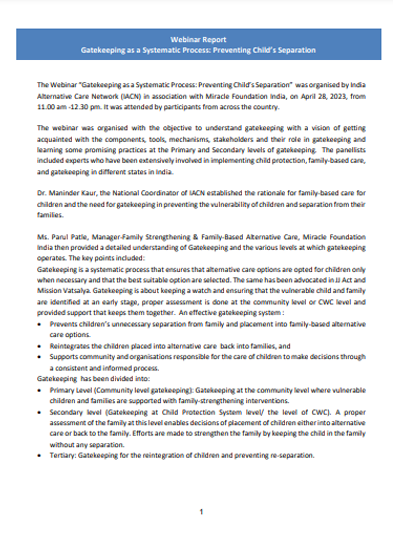
The Webinar “Gatekeeping as a Systematic Process: Preventing Child’s Separation” was organised by India Alternative Care Network (IACN) in association with Miracle Foundation India, on April 28, 2023 and was attended by participants from across the country. The webinar was organised with the objecti ve to understand gatekeeping with a vision of getting acquainted with the components, tools, mechanisms, stakeholders and their role in gatekeeping and learning some promising practices at the Primary and Secondary levels of gatekeeping. This report presents key learnings from the webinar.
Does de-institutionalization always serve ‘best interest’ of the child – A study of the ground realities of restoration of Children
This paper is the result of a field study conducted by Catalysts for Social Action (CSA) on the outcomes of restoration of 29 ‘Children in Need of Care and Protection’ (CNCP) who were residing in Child Care Institutions (CCIs) in Madhya Pradesh. The study was conducted in the year 2018-19 to analyse the process which was followed, to look into the followup and support provided after the child was restored with the family, to gather information on the situation of the child, and find out the effect of deinstitutionalisation on various growth and development parameters of the children. The core argument of this paper is that while every child has a right to grow up with his / her family and the Government’s efforts towards restoration of institutionalised children with their family is a step in the right direction, undertaking the exercise without diligently following due process, without ascertaining whether the risk due to which the child was institutionalised has been mitigated, without ensuring that the family is supported to care for the child, and without periodic monitoring of the effect of restoration on the child, can lead to adverse outcomes for the child, contrary to the envisaged objective of restoration. This argument is supported by findings of the study, which reveals gaps in the system and indicates a degree of non-compliance with critical steps of the process. As a result, most of the children restored with their family were found to be living in detrimental circumstances. This leads to the question as to whether the deinstitutionalisation or restoration of children with family indeed proved to be in the best interest of the child, as it has been envisaged to be. In its conclusion, the paper recommends actions for policymakers and for the implementers drawing from finding of the study and CSA’s experience of working with stakeholders in the child protection system.