
Plan B Strategy Rapid Return
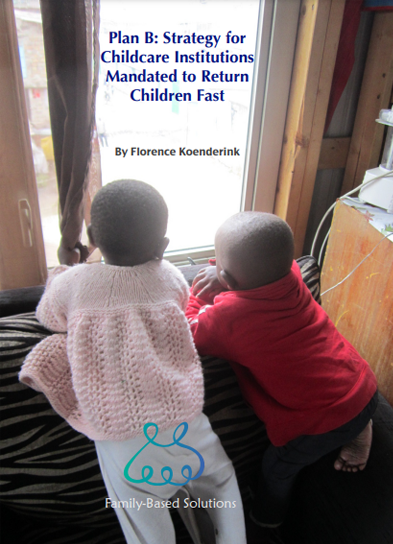
Florence’s article
Foster Family Renewed Hope and New Life: A study on the practice of foster care for children in India
This study is a systematic exploration in understanding foster care practices to promote and spread the concept. The research study documents the practices and initiatives are undertaken on foster care practices in nine states in India and provides an-in-depth documentation of insights, challenges a nd learnings and the way forward to provide an outline for foster care in India, in the backdrop of lack of a common framework.
The Report of the Committee For Analysing Data of Mapping and Review Exercise of CCIs under JJA, 2015 and Other Homes
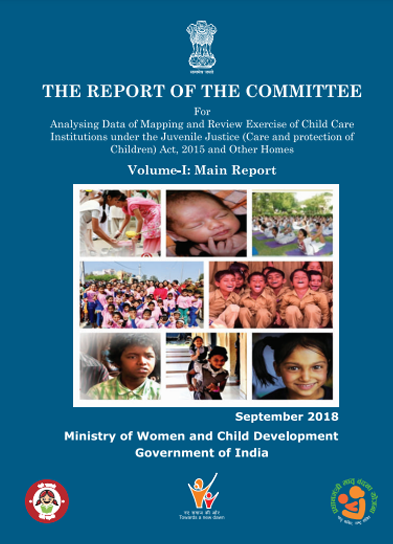
There have been various instances, wherein the living conditions of CCIs are compromised on living space, sanitation and hygiene, privacy, etc. Realizing this, the Hon’ble Supreme Court of India vide order dated 7th, February 2013 in Writ Petition (CRL) No. 102 of 2007 in the matter of EXPLOI. OF CH ILN. INJ ORPH IN ST. OF TN V/s Union of India & Ors, directed that all Child Care Institutions (CCIs) be registered under various provisions of the Juvenile Justice (Care and Protection of children) Act, 2000, and directed the Govt. of India to undertake a mapping exercise of all CCIs in the country. This was to ensure that CCIs/Homes thereby fall under the mandate of the legislation and ensure the standards of care detailed therein. The National Mapping Exercise involved visits of all the CCIs/Homes in every district across the country during 2016 and collected information on legal status as well as standards of care, and also, ascertained whether children residing in Swadhar and Ujjawala Homes were being connected with the JJ system for care and protection. The overall objective was to create a detailed fact sheet and database of CCIs/Homes in the country providing a long term or residential care for vulnerable children. The present report, the outcome of the analysis of data generated through this mapping exercise, assumes significance due to the fact that a National Database on functioning of CCIs/ Homes (including their legal status), staffing pattern, facilities and support systems for children, functioning, funding and financial management
Preparation For Social Reintegration Among Young Girls Leaving Residential Care In India

This study focuses on the preparation for the social reintegration of young Indian girls about to leave their residential care homes. It assesses the level of preparation by capturing the perception of readiness of 100 girls in institutions: whether they expect to complete higher education, and whet her they believe they have acquired such skills as searching for a job, managing finances, problem-solving, and maintaining satisfactory relationships. It also explores the impact of different factors, such as the present age of the girls, their self-esteem, and the availability of support networks, on the preparation for their social reintegration. Overall, the findings revealed that the girls felt better prepared with life skills and access to housing after leaving care, but were not so hopeful about their psychological well-being and ability to access higher education, social support, employment, and financial independence. Factors such as age, educational qualifications, self-esteem, and availability of support while in care had a positive relationship with their preparation for social reintegration. Interestingly, the girls’ level of preparation varied significantly across the eight residential care homes studied. The study is intended to help address gaps in the existing literature and to play a significant role in informing future legislative decisions.
Post Rapid Reunion Strategy

Florence’s article
Foster Care in India: Policy Brief
Based on an analysis of the current provisions of foster care in India, along with the rules and schemes on foster care framed by states in India, more specifically in Delhi and Goa, this policy brief makes recommendations to fill the gaps and shortcomings to move towards a comprehensive legal frame work for foster care. It also includes analyses of the best practices from other countries to support the recommendations.
INDIVIDUAL CARE PLAN, Form 7 of Juvenile Justice (Care and Protection of Children) Act 2015 with addendum
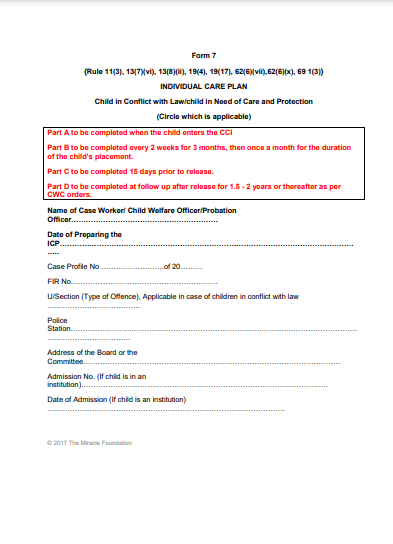
Every child is unique and has a unique set of needs. Individual care plan ( ICP) is required for understanding and assessing the progress of the education, vocational training, physical and mental health needs of a child while in the care system. It was realised that in the absence of any guidelines related to areas of concerns and proposed interventions, most of the domains remained either empty or checked as not applicable in the ICP form. The additions provide a holistic view of the child’s background and help in effective planning and decision regarding placement and well-being of the child. Therefore Miracle has made necessary additions (in red) in the ICP form without deleting any point from the existing ICP form in Juvenile Justice (Care and Protection) Act 2015. These guidelines will be particularly useful to the Social Worker/Probation Officer who prepare plans and to the District Child Protection Units (DCPU) which monitor them. The ICP form with addendum by Miracle Foundation India has been widely used by the Social workers in Miracle mentored Child Care Institutions (CCI) since 2018, and they found a transformational difference in the child and family assessment with a crisp and clear intervention plan. It helped them in making a decision about the child through the case management process in consultation with the child and family members. Under a joint partnership with the State Departments, UNICEF and Miracle Foundation India, the use of ICP with the addendum has been started by some DCPU officials in Gujarat, Jharkhand, Bihar and Maharashtra. Most of the participants have shared feedback with Miracle team that they found the ICP addendums useful reference to support them in conducting and authentically filling up the ICP form for children. Udayan Care referred to the Miracle Foundation India addendum to the ICP form for preparing Individual Care plan (ICP) guidelines for children in the age group of 15 to 18 years for their After Care Model Program in Bihar.
Together for Children: A Community’s Journey

In 2014, Leher partnered with Sarvo Prayas Sansthan (SPS) to develop and implement a community based preventive child protection initiative in the district of Madhubani in Bihar. The program focuses on organizing and capacity building communities, to take self-driven initiative and to work in collab oration with the government to protect and keep their children safe. We adopt a participatory approach to the work in communities, encouraging them to set the agenda for issues they want to address. The position taken with communities is that this program does not bring the answers, but would instead hand hold communities through a journey of transformation, where we learn and find answers together from resources which, exist in the environment. Into the third year of work in Madhubani, this report is a documentation of learning and insights from the field.
Foster Care

This booklet covers the latest legal and policy framework on foster care in India. The purpose of this documentation is to make people in the field of child protection comprehend the concept of foster care in India. This booklet has been written for child care practitioners, those working in the gov ernment offices, members of District Child Protection Units, Child Welfare Committees and Juvenile Justice Boards, social workers, caregivers, staff and management at child care institutions, State agencies as well as by beginners and volunteers in the field of Alternative Care.
Social Investigation Report, Form 22 of Juvenile Justice (Care and Protection of Children) Act 2015 with addendum
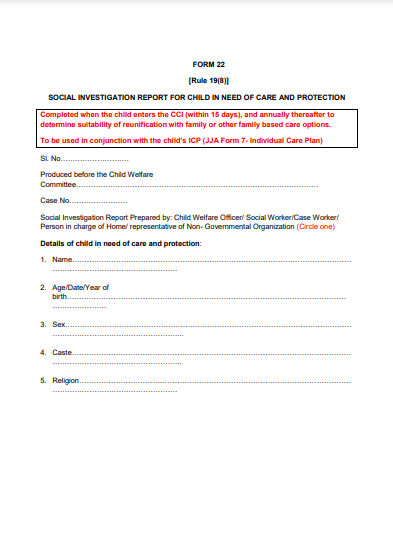
The purpose of the Social Investigation Report (SIR) is to assess the child and family situation to determine if reunification or alternate family placements are feasible. The questions, as mentioned in the SIR needed to be categorised under the well-being domains of the child and family along with some additional points. The additions provide a holistic view of the child’s situation and help in effective planning and decision regarding placement and well-being of the child. Therefore Miracle Foundation India has made necessary additions (in red) SIR forms without deleting any point from the existing SIR forms in Juvenile Justice (Care and Protection) Act 2015. These guidelines will be particularly useful to the Social Worker/Probation Officer who prepare plans and to the District Child Protection Units (DCPU) which monitor them. Both tools have been widely used by the Social workers in Miracle mentored Child Care Institutions (CCI) since 2018, and they found a transformational difference in the child and family assessment with a crisp and clear intervention plan. It helped them in making a decision about the child through the case management process in consultation with the child and family members. Under a joint partnership with the State Departments, UNICEF and Miracle Foundation India, the use of SIR with the addendum has been started by some DCPU officials in Gujarat, Jharkhand, Bihar and Maharashtra. Most of the participants have shared feedback with Miracle team that they practically found the SIR addendums useful reference to support them in conducting and authentically filling up the SIR form for children.