
Assessing the Impact of COVID-19 and the Support Provided to Youth Leaving Care in India
This paper was published in the Youth Journal in March 2022. This study aimed to assess the impact of COVID-19 on Care Leavers’ journeys and well-being, support received through the Aftercare Outreach Programme (AOP), thereby focusing on identifying and understanding the process and support services that should be considered for the further mitigation of their situation during and beyond the pandemic. It also aimed to highlight the impact of AOP support on their health, housing, education, vocational skills, employment, digital access, and mental health. The study examined the criticality of actions required to aid the betterment of their overall situation with respect to managing their mental health, education, and skills, preparing them to cope amidst the pandemic.
Order: Directorate Women and Child Development, Madhya Pradesh- Nodal Officer for Care Leavers

The Juvenile Justice Committee High Court in its meeting dated 23.07.2022, declared the Assistant Director ICPS as nodal officer who will be responsible for providing all necessary support to care leavers, boys and girls, related to subsequent programs under the Mission Vatsalya Scheme.
Introducing Mission Vatsalya: Stakeholders’ Perspectives- Seminar Report
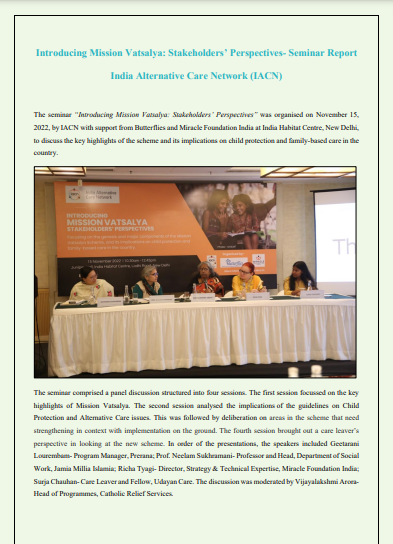
This report aims to discuss the key highlights of the seminar ‘Introducing Mission Vatsalya: Stakeholders’ Perspectives’ organised by IACN with support from Butterflies and Miracle Foundation India at India Habitat Centre, New Delhi. It sheds light on the scheme and its implications on child protect ion and family-based care in the country
DEINSTITUTIONALISATION: DECODING THE ‘WHAT’ AND THE ‘WHY’- Twitter Chat Report
The Twitter Chat on Deinstitutionalisation: Decoding the ‘What’ & the ‘Why’ hosted by Prerana in collaboration with India Alternative Care Network (IACN) on 21st February 2023 saw some crucial insights flowing in from sector experts – Catalyst for Social Action (CSA), Child in Need Institute (CINI), India Alternative Care Network (IACN), Miracle Foundation India, Prerana, Udayan Care and UNICEF India.
Protocol for Restoration and Repatriation of Children
GHAR- Go Home and Re-unite
Aftercare Outreach Program – Intervention for Youth Leaving Care in India
Challenges and experiences of Care Leavers, and more so in COVID-19 times, encouraged Udayan Care to start an intervention for providing extended support to Care Leavers from other CCIs too, who may not have access to support and are expected to survive on their own upon reaching adult hood. Based on concerns, evidence, and years of experience as practitioners, Udayan Care started a program, the Aftercare Outreach Program (AOP), to support financially as well as by close hand-holding and mentoring support for educational and vocational skills attainment, housing, and basic needs, employability skills, leading to gainful employment.
Tracing the Evolution of Alternative Care for Children in India in the Last Decade and the Way Forward
This paper intends to capture the landscape of alternative care and its evolution in India, drawing from the review of the legal and policy framework, existing literature, and detailed discussions with CSOs and State functionaries. It brings out the role of stakeholders, good practices and challenge s in implementing alternative care over the last decade, and provides recommendations for achieving a safe and nurturing family environment for children in vulnerable situations.
Assessment of Strategies to develop Resilience in Children in a Residential Child Care Model of India
This study investigates a longitudinal 5-year sample of 121 children without parental care, living in group residential homes, Udayan Ghars, established by Udayan Care, a non-profit organisation based in India. The participant population, like most children without parental care, has experienced tre mendous adversities, ranging from death in the family and abuse to extreme financial and social insecurity.
Reinstating Hope: Insights from CINI’s Model of Family Reunification
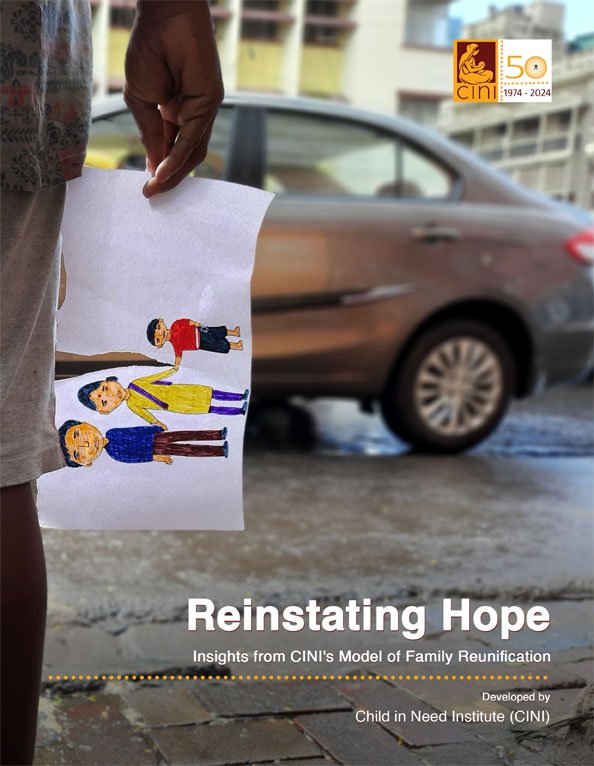
The CINI Method has been distilled out of nearly 50 years of practice with deprived communities, within the framework of international forward-looking thinking. It provides a methodological model to promote the adoption of a child rights-based approach to programming for children involving primary d uty-bearers in the government, service provision and the family. Through this unique methodology, CINI provides preventive and participatory responses integrating interventions in the core areas of health, nutrition, education and child protection.
Transitioning Children from Institutional Care towards Family-Based Care
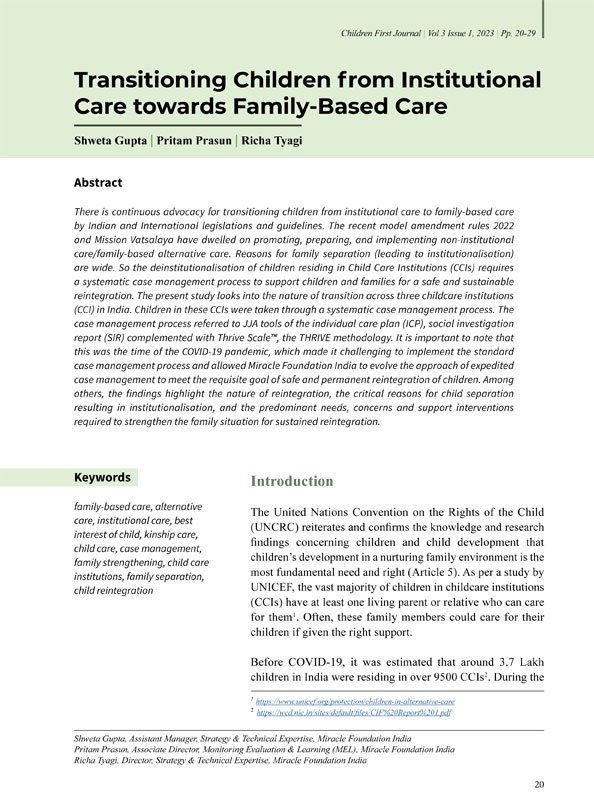
The present study looks into the nature of transition across three childcare institutions (CCI) in India. Children in these CCIs were taken through a systematic case management process. The case management process referred to JJA tools of the individual care plan (ICP), social investigation report ( SIR) complemented with Thrive Scale™, the THRIVE methodology. It is important to note that this was the time of the COVID-19 pandemic, which made it challenging to implement the standard case management process and allowed Miracle Foundation India to evolve the approach of expedited case management to meet the requisite goal of safe and permanent reintegration of children.