
Foster Care in India: Policy Brief
Based on an analysis of the current provisions of foster care in India, along with the rules and schemes on foster care framed by states in India, more specifically in Delhi and Goa, this policy brief makes recommendations to fill the gaps and shortcomings to move towards a comprehensive legal frame work for foster care. It also includes analyses of the best practices from other countries to support the recommendations.
INDIVIDUAL CARE PLAN, Form 7 of Juvenile Justice (Care and Protection of Children) Act 2015 with addendum
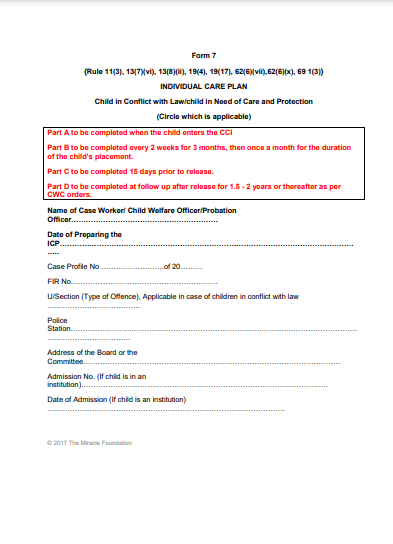
Every child is unique and has a unique set of needs. Individual care plan ( ICP) is required for understanding and assessing the progress of the education, vocational training, physical and mental health needs of a child while in the care system. It was realised that in the absence of any guidelines related to areas of concerns and proposed interventions, most of the domains remained either empty or checked as not applicable in the ICP form. The additions provide a holistic view of the child’s background and help in effective planning and decision regarding placement and well-being of the child. Therefore Miracle has made necessary additions (in red) in the ICP form without deleting any point from the existing ICP form in Juvenile Justice (Care and Protection) Act 2015. These guidelines will be particularly useful to the Social Worker/Probation Officer who prepare plans and to the District Child Protection Units (DCPU) which monitor them. The ICP form with addendum by Miracle Foundation India has been widely used by the Social workers in Miracle mentored Child Care Institutions (CCI) since 2018, and they found a transformational difference in the child and family assessment with a crisp and clear intervention plan. It helped them in making a decision about the child through the case management process in consultation with the child and family members. Under a joint partnership with the State Departments, UNICEF and Miracle Foundation India, the use of ICP with the addendum has been started by some DCPU officials in Gujarat, Jharkhand, Bihar and Maharashtra. Most of the participants have shared feedback with Miracle team that they found the ICP addendums useful reference to support them in conducting and authentically filling up the ICP form for children. Udayan Care referred to the Miracle Foundation India addendum to the ICP form for preparing Individual Care plan (ICP) guidelines for children in the age group of 15 to 18 years for their After Care Model Program in Bihar.
Together for Children: A Community’s Journey

In 2014, Leher partnered with Sarvo Prayas Sansthan (SPS) to develop and implement a community based preventive child protection initiative in the district of Madhubani in Bihar. The program focuses on organizing and capacity building communities, to take self-driven initiative and to work in collab oration with the government to protect and keep their children safe. We adopt a participatory approach to the work in communities, encouraging them to set the agenda for issues they want to address. The position taken with communities is that this program does not bring the answers, but would instead hand hold communities through a journey of transformation, where we learn and find answers together from resources which, exist in the environment. Into the third year of work in Madhubani, this report is a documentation of learning and insights from the field.
Foster Care

This booklet covers the latest legal and policy framework on foster care in India. The purpose of this documentation is to make people in the field of child protection comprehend the concept of foster care in India. This booklet has been written for child care practitioners, those working in the gov ernment offices, members of District Child Protection Units, Child Welfare Committees and Juvenile Justice Boards, social workers, caregivers, staff and management at child care institutions, State agencies as well as by beginners and volunteers in the field of Alternative Care.
Social Investigation Report, Form 22 of Juvenile Justice (Care and Protection of Children) Act 2015 with addendum
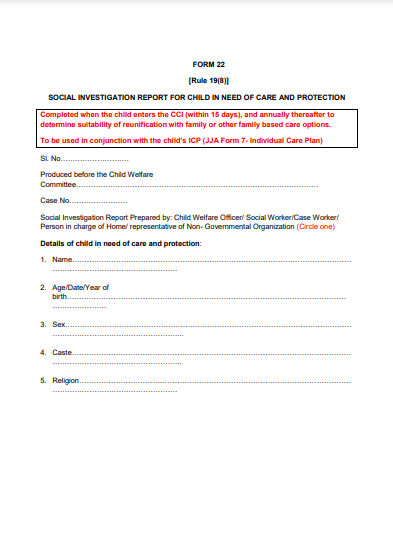
The purpose of the Social Investigation Report (SIR) is to assess the child and family situation to determine if reunification or alternate family placements are feasible. The questions, as mentioned in the SIR needed to be categorised under the well-being domains of the child and family along with some additional points. The additions provide a holistic view of the child’s situation and help in effective planning and decision regarding placement and well-being of the child. Therefore Miracle Foundation India has made necessary additions (in red) SIR forms without deleting any point from the existing SIR forms in Juvenile Justice (Care and Protection) Act 2015. These guidelines will be particularly useful to the Social Worker/Probation Officer who prepare plans and to the District Child Protection Units (DCPU) which monitor them. Both tools have been widely used by the Social workers in Miracle mentored Child Care Institutions (CCI) since 2018, and they found a transformational difference in the child and family assessment with a crisp and clear intervention plan. It helped them in making a decision about the child through the case management process in consultation with the child and family members. Under a joint partnership with the State Departments, UNICEF and Miracle Foundation India, the use of SIR with the addendum has been started by some DCPU officials in Gujarat, Jharkhand, Bihar and Maharashtra. Most of the participants have shared feedback with Miracle team that they practically found the SIR addendums useful reference to support them in conducting and authentically filling up the SIR form for children.
Supporting Youth Leave Care: A Study of Aftercare Practices, in Rajasthan (2019)
Current Aftercare Practices (CAP) is a research study conducted in the State of Rajasthan and is part of a multistate study conducted in Delhi, Gujarat, Karnataka, and Maharashtra. The CAP study is an Udayan Care initiative, supported and funded by UNICEF, Tata Trusts and other partners; and is base d on the premise that every child who leaves an Alternative Care setting on completing 18 years of age (or becomes a ‘Care Leaver’) needs extended support in the form of Aftercare. The CAP study gathers evidence through a scientific data collection process, consolidates knowledge and promising practices, and discusses gaps and challenges from multi-stakeholders’ perspective. At various stages, the study has employed participatory methods to incorporate the voices of CLs and critical feedback from key stakeholders and experts. The report covers a total of 98 young adults from Rajasthan, comprising of 40 males and 58 females CLs, from both Government and NGO-run Child Care Institutions (CCIs) and 17 youth who, as children, availed the benefits under the Palanhar scheme of the Rajasthan Government. A total of 25 key informants were also interviewed as part of the study. Currently, Aftercare provision under the JJ Act and its Rules is meant only for CLs exiting from CCIs and is not applicable for Palanhar beneficiaries in the State. Although much work on child protection is happening in the State, there are many areas, one of them being Aftercare, where duty bearers need to rise to the call to meet the aspirations of the youth and CLs.
Building a Life: Akbar’s Story

‘Building a life’ is a story of a now 21-year-old Akbar hailing from the infamous red-light area of Kamathipura, Mumbai. This story best explains how Prerana’s interventions were guided by the principles under the JJ Act, 2015 – the principle of best interest, family responsibility, and institution alization as a measure of last resort for rehabilitation. Akbar’s journey, from 2005 till date, comprises overcoming innumerable challenges innate to the red-light area (from being in and out of childcare institutions to dealing with severe medical conditions, and so on), forming strong familial bonds, and building a dream and a life of rights, choices, and dignity. Throughout Akbar’s journey, Prerana has been instrumental in ensuring that he and his family (his mother and four siblings) receive timely counseling, regular medical assessments, enrollment in educational and recreational programs, and rehabilitation whenever necessary through regular follow-ups and outreach.
User Guide on Foster Care
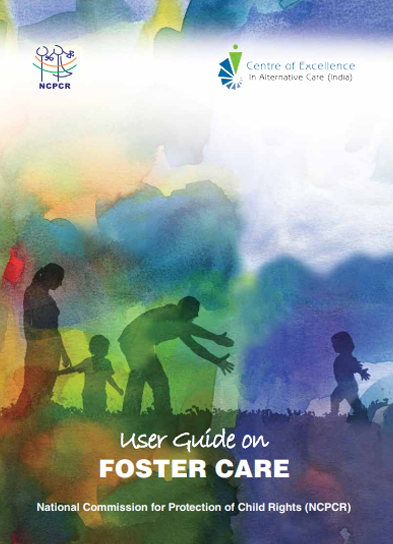
This User Guide aims to provide a comprehensive approach to the development of a good quality foster care service, which will be useful for a range of practitioners including the Child Welfare Committee (CWC) responsible for approval and monitoring of foster families, District Child Protection Unit (DCPU) responsible for developing the foster care service, NGOs who may support foster care, and any individual or organisation who has a role to play.
Mapping Long-term Outcomes of Institutionalization for Children in Need of Care and Protection (CNCP) in India
This research maps the long term outcomes of institutional care on children in India and is undertaken by Make A Difference; a non-profit working with children in need of care and protection (CNCP) across 23 cities in India with the long term aim of driving transformative life outcomes on par with t he middle class for all children in care. Approximately 35m children are estimated to fall into the CNCP category, with nearly half a million registered in institutional care and potentially half a million more in institutions that are yet to register as per the 2015 amendment to the JJ Act, which is still only slowly percolating into local awareness. The goal of this research is to challenge or validate the assumptions that underpin existing impact and change-focused solutions; to combat the complete dearth of data and lack of meaningful information available in the sector about the longer-term effects of institutional care on children in India, and to enable programmes both within and outside of Make A Difference to be designed on the back of benchmarked and trackable outcomes.
Supporting Youth Leave Care: A Study of Aftercare Practices in Maharashtra (2019)
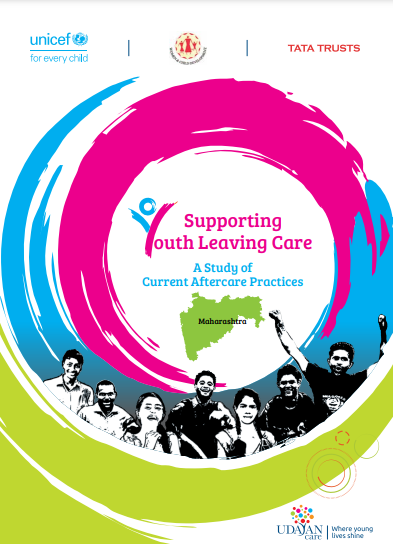
Current Aftercare Practices (CAP) is a research study conducted in the State of Maharashtra and is part of a multistate study conducted in Delhi, Gujarat, Karnataka, and Rajasthan. The CAP study is an Udayan Care initiative, supported and funded by UNICEF, Tata Trusts and other partners; and is base d on the premise that every child who leaves an Alternative Care setting on completing 18 years of age (or becomes a ‘Care Leaver’) needs extended support in the form of Aftercare. The CAP study gathers evidence through a scientific data collection process, consolidates knowledge and promising practices, and discusses gaps and challenges from multi-stakeholders’ perspective. At various stages, the study has employed participatory methods to incorporate the voices of CLs and critical feedback from key stakeholders and experts. The report covers a total of 107 CLs from Maharashtra, comprising of 74 males and 33 females, from both Government and Non-Governmental Organisation (NGO) run Child Care Institutions (CCIs). The key findings of the study show that Maharashtra has a rich historical background of Aftercare, yet there is tremendous scope for further development. Although, much is happening on Aftercare in the State, there are many areas where we, as duty-bearers, need to rise to the call to meet the aspirations of the CLs.