
Aftercare For Young Adult Orphans
After reaching 18 years, children in CCIs are required to leave and often fall off the radar. This lack of visibility in aftercare is an area of concern in India, and there are yawning gaps in the ‘Aftercare’ service of these Care Leavers, many of whom are orphans. They face heightened challenges a nd poorer outcomes on the journey to independence, not only because of their fractured pasts but also due to a lack of planned interventions towards preparing them for life out of CCIs. They face severe issues of shelter, sustenance, documentation of identity, continuing education and finding employment Given the importance of developing a holistic policy for the aftercare of young adult orphans; PIC decided to undertake a study in collaboration with STAPI, a nodal agency designated by the Government of Maharashtra.
Model for alternative care reform
Florence’s article
Research Paper: Kinship Care
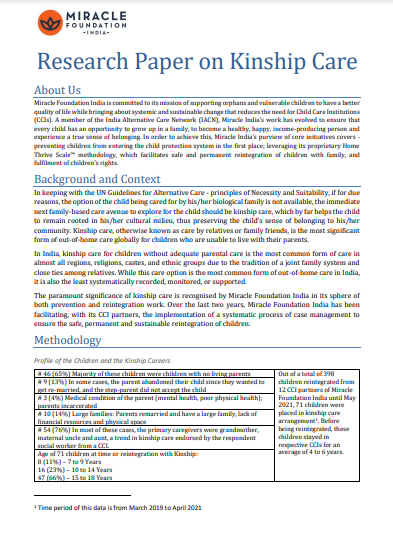
In India, kinship care for children without adequate parental care is the most common form of care in almost all regions, religions, castes, and ethnic groups due to the tradition of the joint family system and close ties among relatives. While this care option is the most common, it is also the lea st systematically recorded, monitored, or supported option. In light of the above statement, Miracle Foundation India, with the support of our CCI partners, is trying to take active measures to ensure systematic implementation of the case management process for the safe, permanent, and sustainable reintegration of children. The Miracle Foundation has hence conducted a study in May 2021 which examined the success of children reintegrated into kinship care over the past 2 years. The study was Miracle Foundation India’s contribution to the paper on kinship care to be submitted to UNGA DGD. Along with CINI and Shishuadhar, under the aegis of IACN, a small team at Miracle Foundation India was created to pull the practical insights together. Primary data was collected within the purview of experiences, challenges, and recommendations and analysed by the Miracle team. The findings from data analysis through structured interviews with concerned stakeholders and analysis of data of the 71 children (reintegrated to kinship care) from the case management tracker—a tracking system developed by Miracle Foundation India covering all six stages of the case management process—helped in capturing the experiences, challenges, and recommendations for strengthening the kinship care system which is elaborated in the report.
Standards of Care in Child Care Institutions
This booklet covers the latest legal and policy framework, key procedures and do’s and don’ts for child care professionals on standards of care in Child Care Institutions. This booklet has been written for child care practitioners, those working in the government offices, members of District Child P rotection Units, Child Welfare Committees and Juvenile Justice Boards, social workers, caregivers, staff and management at child care institutions, State agencies as well as by beginners and volunteers in the field of Alternative Care.
Aftercare

This booklet covers the latest legal and policy framework on aftercare in India. The purpose of this documentation is to make people in the field of child protection comprehend the concept of aftercare in India. This booklet has been written for child care practitioners, those working in the governm ent offices, members of District Child Protection Units, Child Welfare Committees and Juvenile Justice Boards, social workers, caregivers, staff and management at child care institutions, State agencies as well as by beginners and volunteers in the field of Alternative Care.
Plan B Strategy Rapid Return
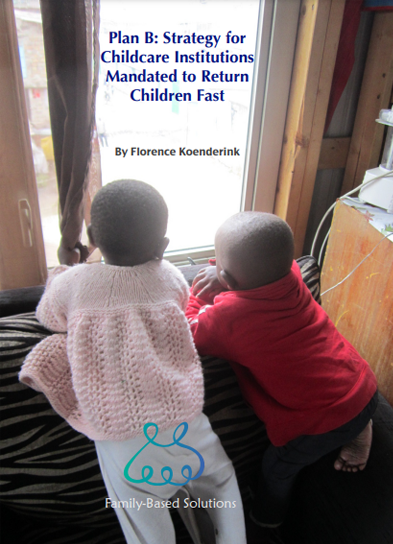
Florence’s article
Foster Family Renewed Hope and New Life: A study on the practice of foster care for children in India
This study is a systematic exploration in understanding foster care practices to promote and spread the concept. The research study documents the practices and initiatives are undertaken on foster care practices in nine states in India and provides an-in-depth documentation of insights, challenges a nd learnings and the way forward to provide an outline for foster care in India, in the backdrop of lack of a common framework.
The Report of the Committee For Analysing Data of Mapping and Review Exercise of CCIs under JJA, 2015 and Other Homes
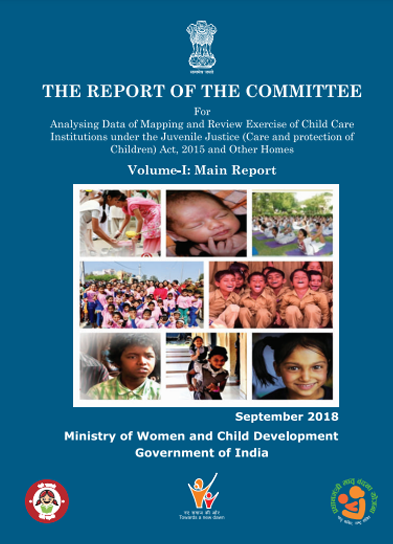
There have been various instances, wherein the living conditions of CCIs are compromised on living space, sanitation and hygiene, privacy, etc. Realizing this, the Hon’ble Supreme Court of India vide order dated 7th, February 2013 in Writ Petition (CRL) No. 102 of 2007 in the matter of EXPLOI. OF CH ILN. INJ ORPH IN ST. OF TN V/s Union of India & Ors, directed that all Child Care Institutions (CCIs) be registered under various provisions of the Juvenile Justice (Care and Protection of children) Act, 2000, and directed the Govt. of India to undertake a mapping exercise of all CCIs in the country. This was to ensure that CCIs/Homes thereby fall under the mandate of the legislation and ensure the standards of care detailed therein. The National Mapping Exercise involved visits of all the CCIs/Homes in every district across the country during 2016 and collected information on legal status as well as standards of care, and also, ascertained whether children residing in Swadhar and Ujjawala Homes were being connected with the JJ system for care and protection. The overall objective was to create a detailed fact sheet and database of CCIs/Homes in the country providing a long term or residential care for vulnerable children. The present report, the outcome of the analysis of data generated through this mapping exercise, assumes significance due to the fact that a National Database on functioning of CCIs/ Homes (including their legal status), staffing pattern, facilities and support systems for children, functioning, funding and financial management
Preparation For Social Reintegration Among Young Girls Leaving Residential Care In India

This study focuses on the preparation for the social reintegration of young Indian girls about to leave their residential care homes. It assesses the level of preparation by capturing the perception of readiness of 100 girls in institutions: whether they expect to complete higher education, and whet her they believe they have acquired such skills as searching for a job, managing finances, problem-solving, and maintaining satisfactory relationships. It also explores the impact of different factors, such as the present age of the girls, their self-esteem, and the availability of support networks, on the preparation for their social reintegration. Overall, the findings revealed that the girls felt better prepared with life skills and access to housing after leaving care, but were not so hopeful about their psychological well-being and ability to access higher education, social support, employment, and financial independence. Factors such as age, educational qualifications, self-esteem, and availability of support while in care had a positive relationship with their preparation for social reintegration. Interestingly, the girls’ level of preparation varied significantly across the eight residential care homes studied. The study is intended to help address gaps in the existing literature and to play a significant role in informing future legislative decisions.
Post Rapid Reunion Strategy

Florence’s article